Politics
Lawmakers Grill Illinois Department of Corrections After Audit Shows Dozens of Failures
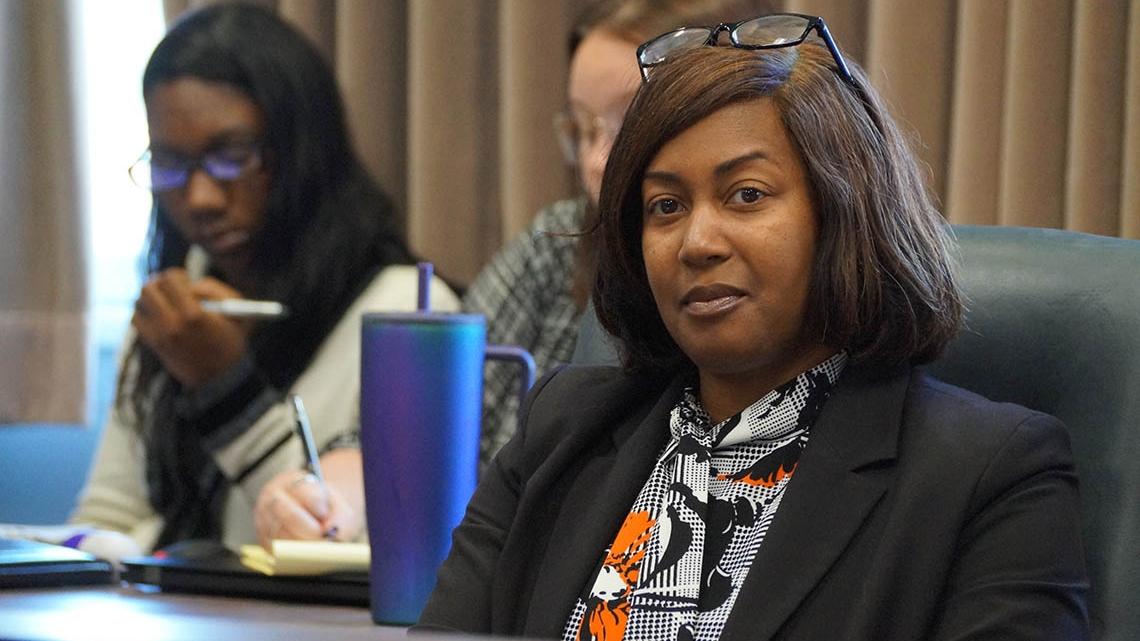 Illinois Department of Corrections Director LaToya Hughes was confirmed as department director in October and has led it since 2023. (Peter Hancock / Capitol News Illinois)
SPRINGFIELD — Illinois lawmakers are fed up with the state Department of Corrections after another audit found it has ignored state spending rules and failed to fix many mistakes that have languished for years.
The Legislative Audit Commission, a bipartisan commission of state lawmakers that reviews audits of state agencies, demanded answers from Corrections Director LaToya Hughes on Tuesday. An audit of her department in fiscal years 2023 and 2024 that was released in September revealed 40 shortcomings at the agency, making it one of the worst in the state.
The department allowed employees to earn overtime hours while working during paid leave, violated state purchasing rules and failed to maintain a list of paroled inmates who moved to other state facilities, according to the audit.
“I don’t know why the two worst-run departments in the state are the ones that deal with lives of people ... We are being fleeced – the taxpayers,” commission co-chair Sen. Chapin Rose, R-Mahomet, said. “You are putting people’s lives at risk.”
The audit revealed numerous problems that could cost the state millions of dollars or jeopardize public safety.
“There is literally nothing that you guys can say that I would believe,” Rose said. “And honestly, it’s about the safety of people in the state and the safety of the men and women that work there.”
The commission did not vote to accept the findings of the audit, meaning the department will have to return to answer more questions from lawmakers on their progress addressing the problems.
Overtime Pay
Auditors took issue with how the department allows employees to earn overtime. Eighty percent of the employees reviewed by auditors recorded overtime on the same days they also received paid leave. Employees who took time off were still coming to work and getting paid for both their time off and having the hours they worked that day counted as overtime.
“Someone could take 37.5 hours, or 40 hours depending on what their schedule is, they could take a week’s vacation, they could come in and work a four-hour shift and that four hours would be paid in overtime even though they haven’t been in the office?” asked Rep. Amy Elik, R-Godfrey.
Hughes, who took over the department in 2023 and was confirmed by the Senate the month after the audit was released, said Elik’s assessment was correct and blamed the practice on DOC’s union contract.
Auditors wrote in their assessment that the problem has persisted since 2014 despite prior commitments from the department to address the issue. The Department of Corrections had a $2.1 billion budget in FY24 and overtime cost the state $150 million.
The department is also behind the times on timekeeping.
“The department at one point in time did attempt to digitize the timekeeping process,” Hughes said. “They were unable to do so at the time so that process is still a manual process.”
Purchasing Issues
The department has also resorted to more frequently using the state’s emergency procurement process, according to the audit, which allows it to circumvent the slower bidding process for contracts and purchases.
The department spent millions on new vehicles through the emergency process in early 2023. It was not clear why all vehicles were purchased outside the normal bid process. DOC chief administrator Jared Brunk said the department’s vendor for vehicles wasn’t able to make an order for vans through their contract and the department made the decision to buy them under an emergency designation.
The department also made a $692,640 emergency purchase for sliced bread in mid-2023, a product typically made by the department itself at Illinois River Correctional Center in Fulton County.
“Isn’t it foreseeable that you need sliced bread to feed inmates?” Rose asked.
Brunk said DOC ran into a supply chain issue at the time and decided to purchase the bread instead.
Public Safety
Other revelations in the audit pertained to possible public safety issues.
Auditors found the department did not have a list of people on parole or mandatory supervised release who became residents of state facilities run by the departments of public health, human services or health care and family services.
More than 15,000 people are in DOC custody on parole or supervised release and the department is required to notify local police agencies when a person under those release conditions is living in their community.
State law requires DOC to supervise sex offenders on mandatory supervised release and report to police agencies on their compliance with release conditions. But the department has failed to do so.
In addition, some people in DOC custody were improperly labeled as violent sexual offenders, despite having not committed such a crime. Alyssa Williams, assistant DOC director, blamed state’s attorneys and courts for not providing enough information to help the department make a determination.
“It’s sort of the ultimate irony that you’re housing people accused of violating the state law and then you guys are violating the state law,” Rose said.
Capitol News Illinois is a nonprofit, nonpartisan news service that distributes state government coverage to hundreds of news outlets statewide. It is funded primarily by the Illinois Press Foundation and the Robert R. McCormick Foundation.
This article first appeared on Capitol News Illinois and is republished here under a Creative Commons Attribution-NoDerivatives 4.0 International License.